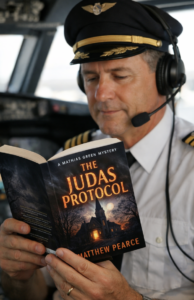
Airline pilots live in a world where details matter, procedures matter, and quiet discipline matters. They are trained to respect systems, interpret signals, stay calm under pressure, and respond with precision when something feels even slightly out of place. That mindset does not shut off when the flight ends. It becomes part of how they think, how they read situations, and often how they choose what kind of stories they enjoy. In an industry shaped every day by sources like the FAA Newsroom, AP’s airlines coverage, and Reuters aerospace and defense coverage, pilots are constantly reminded that judgment, discipline, and clear thinking are never optional.
That is exactly why Mathias Green: The Judas Protocol is such a strong fit for this audience. The novel opens with a theology professor, Silas Hawthorne, found seated upright in a locked archive vault, with no wounds, no signs of struggle, and one hand resting on an uncatalogued manuscript. The death is ruled an anomaly, but Mathias Green does not believe in anomalies. That setup alone carries the kind of tension that appeals to readers who know that when something looks impossible on the surface, the truth is usually buried in the details.
For pilots who appreciate stories driven by observation, logic, consequences, and moral clarity, this is more than entertainment. It is the kind of suspense that respects the reader’s intelligence. It belongs in the conversation around strong christian suspense novels because it combines tension, deeper meaning, and a high-stakes atmosphere without losing control of the story.
A Story Built for Readers Who Notice the Smallest Deviation
Pilots are trained to notice what other people miss. A slight instrument irregularity, a subtle weather shift, an unexpected radio call, a check that does not feel quite right. Good flying is not built on drama. It is built on disciplined awareness. That same instinct makes a certain kind of suspense especially satisfying. The best thrillers are not just fast. They are exact. They reward attention.
The Judas Protocol appears to understand that. Its premise is not built on noise or chaos for the sake of excitement. It is built on a mystery that feels structured. A man is dead in a place that should not permit what happened. The official explanation does not hold. The evidence does not line up cleanly. The investigator refuses to accept the surface-level conclusion. That is a compelling setup for readers who know the danger of signing off too quickly on a bad assumption.
An airline pilot spends a career learning that procedure is not the enemy of insight. Procedure creates the space where insight can actually work. In the same way, a smart suspense novel does not wander aimlessly. It follows pressure lines. It tests people under stress. It reveals character through decisions. That is one reason this book can connect so well with pilots. It respects order while still showing how fragile order can become when hidden truths begin to surface.
Pilots Understand the Weight of Protocol
The word protocol in the title is one of the strongest reasons this book should catch a pilot’s eye. Protocol is not an abstract concept in aviation. It is the framework that protects lives. It carries memory, training, accountability, and the accumulated wisdom of hard lessons. Whether someone flies domestic routes, international routes, cargo, charter, or corporate aircraft, the principle stays the same. Precision is not merely a preference. It is part of the calling.
That is why a title like The Judas Protocol immediately carries weight for an airline professional. It suggests structure, secrecy, trust, betrayal, and the possibility that what is supposed to protect people may also conceal something dangerous. That kind of tension lands differently for readers whose professional lives are defined by checklists, standard operating procedures, crew coordination, and the discipline to act correctly even when adrenaline is high.
The larger aviation world reflects that same constant emphasis on systems and operational seriousness. The IATA Pressroom tracks the pressures shaping the airline industry, the ICAO Newsroom reflects the international regulatory environment, and FlightGlobal aviation news follows how the industry responds to technical, operational, and strategic developments. Pilots do not simply work in transportation. They work inside a living framework of standards, oversight, and nonstop adaptation.
A novel that uses protocol as part of its emotional and intellectual architecture is going to feel more meaningful to people who understand the cost of getting protocol wrong.
Precision Is Not Coldness; It Is Responsibility
One of the biggest misunderstandings outsiders sometimes have about pilots is assuming that procedural discipline makes them emotionally distant. In reality, precision is often an expression of care. Pilots follow the checklist because people matter. They verify because outcomes matter. They communicate clearly because confusion has consequences. The calm exterior is not emptiness. It is stewardship.
That is another reason The Judas Protocol can resonate. Stories like this work best when they show that careful thinking and deep conviction can coexist. A strong suspense novel does not need a reckless hero to keep readers engaged. In many cases, the more compelling lead is the one who keeps thinking clearly while everyone else rushes toward the easiest explanation.
Mathias Green seems positioned in exactly that kind of role. He is not satisfied with a label like anomaly. He presses deeper. He looks again. He treats the unexplained as a signal that something important has been missed. Pilots understand that instinct. In aviation, unexplained does not mean unimportant. It usually means the opposite.
That mindset creates a bond between reader and story. A pilot does not have to stretch to understand why this kind of character matters. The appeal is immediate. Here is someone who refuses to ignore what does not fit. Here is someone who understands that truth can hide behind official language, incomplete conclusions, and the pressure to move on too quickly.
Why the Faith Element Matters Without Weakening the Suspense
There is also a distinct advantage in the Christian dimension of this novel. Too often, readers are forced to choose between books that move quickly and books that mean something. This kind of story suggests they do not have to choose. A Christian suspense novel at its best can offer danger, intrigue, moral conflict, and spiritual depth in the same package.
That matters for airline pilots because many of them carry immense responsibility while also carrying a private need for steadiness, truth, and perspective. The profession requires confidence, but it also confronts people with limits. Weather changes. systems fail. fatigue is real. circumstances shift. A book that explores danger and hidden motives while still holding onto a framework of meaning can feel more satisfying than a thriller built only on shock.
The faith layer also changes the emotional texture of the suspense. Betrayal means more when truth matters. Secrecy feels heavier when morality matters. Courage becomes more than instinct when conscience matters. That gives The Judas Protocol a stronger center. It is not just about solving a puzzle. It is about what that puzzle reveals about people, trust, and the cost of deception.
Even readers who spend much of their time in the practical language of aviation can appreciate that deeper current. Pilots know that discipline without principle eventually weakens. A story that understands both structure and conviction is going to feel fuller than one that relies only on pace.
A Better Kind of Escape for People Who Carry Serious Responsibility
Not every form of escape is equally refreshing. For airline pilots, the best reading often is not something empty. It is something absorbing. After a profession that demands alertness, strong judgment, and composure, many readers want a book that feels sharp, not sloppy. They want immersion without nonsense. They want tension without chaos. They want a story with control.
That is where The Judas Protocol has an edge. Its premise invites the reader into a mystery that appears tightly wound from the first moment. The atmosphere suggests hidden documents, unsettling truths, intellectual danger, and the slow exposure of something carefully buried. Those elements are naturally attractive to readers whose daily lives are built around disciplined interpretation of information.
There is also something fitting about a pilot reading a story like this in the current airline environment. Public understanding of the industry is often shaped by broad reference points such as Wikipedia’s airline overview, while professionals are paying attention to much deeper operational realities reflected by regulators, trade organizations, and credible news outlets. The gap between what the public sees and what professionals know is often significant. Suspense fiction built on hidden layers and deeper realities mirrors that dynamic in a powerful way.
For that reason, this novel is not just a random recommendation for airline pilots. It is a fitting one. It aligns with the habits of mind the profession builds: caution, pattern recognition, patience, moral seriousness, and the refusal to settle for appearances.
Conclusion
Why should airline pilots who live by protocol and precision read Mathias Green: The Judas Protocol? Because the novel appears to speak the language of disciplined minds. It begins with an impossible-looking death, builds tension around hidden truth, and centers the kind of careful reasoning that pilots respect. It carries the gravity of protocol, the pull of mystery, and the added depth of a Christian worldview without sounding shallow or careless.
For readers in aviation, that combination matters. Pilots do not spend their lives trusting impulse over process. They understand that the smallest inconsistency can point to the biggest truth. They know that calm thinking is not weakness. They know that procedure and conviction belong together. The Judas Protocol seems built for that kind of reader.
For an airline pilot looking for a novel that feels intelligent, tense, meaningful, and sharply constructed, this is the kind of book that deserves a place in the flight bag, on the nightstand, or in the carry-on before the next trip.