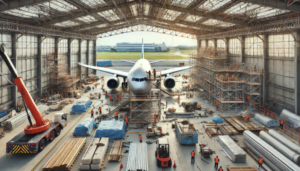
An airline hangar is not just a big building with a big door. It is a controlled environment where aircraft, equipment, and people rely on protection from wind, rain, heat, and debris. When the roof starts failing, it does not stay a “small facilities problem” for long. It becomes a safety risk, a schedule risk, and a cost multiplier that hits maintenance timelines, parts storage, tooling, and the aircraft itself. ✈️
Below are the real-world situations that signal an airline hangar needs roof repair services, with a clear focus on operational impact and risk reduction.
Water Intrusion Shows Up Anywhere Inside the Hangar
A hangar roof can leak in obvious ways, like dripping over a work area, but the most dangerous leaks are often the quiet ones. Water can travel along purlins, seams, insulation layers, and conduit before it finally appears far from the original entry point. That means a “small stain” can represent a much larger failure zone above.
Roof repair becomes urgent when moisture shows up near sensitive areas such as avionics benches, parts cages, tool cribs, electrical rooms, or anywhere close to aircraft surfaces. Even minor water intrusion can lead to corrosion, compromised sealants, slippery floors, and avoidable foreign object debris risk as ceiling materials deteriorate.
Roof Membranes, Seams, and Fasteners Start Failing Under Constant Exposure
Hangars take relentless weather abuse. UV exposure, thermal cycling, heavy winds, and repeated expansion and contraction all stress roof membranes and metal roof systems. Over time, seams separate, adhesives weaken, fasteners back out, and flashing loses its seal. If the roof has aged past its prime, failures start stacking up quickly.
Roof repair services become necessary when you see seam splits, lifted edges, missing fasteners, punctures from debris, or recurring patchwork in the same areas. Repeated “temporary fixes” are a sign the roof is no longer acting like a system. It is acting like a collection of bandages.
After Major Wind Events, Uplift Risk Becomes a Real Threat
Hangars are large-span structures, and that size makes roofs more vulnerable to wind uplift. A roof can look fine from the ground while the perimeter edges, corners, and parapet transitions are partially detached. Those are the zones where wind loads concentrate, and where small failures can cascade.
Repair is needed when there is evidence of lifted flashing, flapping membrane, displaced coping, warped edge metal, or new rattling and vibration during storms. Wind damage is also one of those issues where speed matters, because the next weather event can turn “repairable” into “replacement-level” damage.
Ponding Water, Drain Problems, and Overflow Staining Signal Structural Stress
If a roof holds water after rainfall, that is not cosmetic. Ponding increases load, accelerates membrane deterioration, and finds every weak seam and penetration. Hangars with internal drains, scuppers, or long gutter runs can develop clogs, sagging, or improper slope over time. Overflow staining on exterior walls or chronic wet areas on the roof surface are clear indicators the drainage plan is not functioning as designed.
Roof repair services are needed when ponding persists, drains back up, or you see algae, heavy sediment rings, or degraded coatings around low spots. These symptoms often point to slope failure, blocked drains, crushed insulation, or localized structural settling that requires professional correction.
Rust, Corrosion, and Deterioration Around Penetrations Keep Spreading
Hangar roofs have penetrations everywhere: HVAC curbs, exhaust vents, electrical supports, lightning protection components, skylights, and sometimes fall protection anchors. Each penetration is a potential failure point. Water intrusion around these areas can corrode metal decks, rot blocking, degrade insulation, and weaken roof attachment.
Repair becomes critical when corrosion appears around curbs and flashing, when sealant joints keep cracking, or when insulation becomes saturated. In hangar environments, corrosion also raises concerns about debris and particulates entering work zones, which can create quality issues for inspections and finishes.
Interior Humidity and Condensation Begin Affecting Operations
Not all hangar “roof problems” show up as drips. Some show up as climate control instability. If insulation is compromised or vapor barriers fail, a hangar can develop condensation cycles that create dampness, mildew, and corrosion risk on stored parts and equipment. Condensation can also form on structural members and drip later, making it feel like a roof leak even when the main culprit is thermal and moisture imbalance.
Roof repair services are warranted when insulation is wet, when condensation becomes persistent, or when temperature control costs spike without explanation. A roof system that cannot manage heat and moisture correctly becomes a long-term operational expense.
Damage Near Hangar Doors and Perimeter Transitions Causes Repeat Failures
Hangar doors create unique conditions: pressure changes, vibration, wind turbulence, and movement at the building envelope. The roof areas near door headers, end walls, and perimeter transitions are common failure zones. Small gaps here can invite wind-driven rain, leading to recurring leaks and deterioration along the edges.
When you see repeated water entry near the door line, movement cracks in flashing, or ongoing repairs that never fully resolve the issue, it is time for professional roof repair that addresses the detailing and attachment methods, not just the symptom.
After Hail, Debris Impact, or Equipment Work, Hidden Punctures Need Professional Repair
Hail damage can fracture membranes, dent metal panels, and weaken coatings in ways that are not always obvious until months later. Likewise, rooftop equipment work can cause accidental punctures and seam damage from foot traffic, dropped hardware, and tool impacts. Even small penetrations can allow slow saturation of insulation and create widespread issues over time.
Roof repair services become necessary after impact events, after major rooftop work, or when sudden new leaks appear following maintenance activity. A professional inspection catches the hidden damage that routine walkthroughs miss.
Safety, Compliance, and Insurance Requirements Start Driving the Decision
Airlines operate under strict safety cultures, and facilities are part of that responsibility. When a roof’s condition increases slip hazards, electrical risk, potential mold issues, or structural concerns, repair becomes more than a budget line item. It becomes a liability control measure.
Insurance carriers also pay attention to roof condition, documented maintenance, and storm readiness. Addressing roof problems early can reduce claim disputes, improve insurability, and help avoid emergency closures that disrupt maintenance schedules and aircraft availability.
When Downtime Costs More Than the Repair, the Roof Is Already Late
One of the clearest “when” signals is financial and operational. If maintenance teams are moving equipment to avoid leaks, if bays are taken out of service during storms, if parts storage is being relocated, or if aircraft positioning is affected, the roof is already costing the airline more than repair would have.
Hangar operations are built around predictability. A roof that forces reactive decisions undermines that predictability and creates knock-on costs: rescheduled work, staffing inefficiencies, delayed returns to service, and rushed “emergency fixes” that are rarely cost-effective.
Conclusion
An airline hangar needs roof repair services when the roof stops being a reliable barrier and starts becoming an operational variable. Water intrusion, seam failure, wind uplift damage, ponding, corrosion, condensation issues, perimeter breakdowns, and post-storm impacts all point to the same truth: the roof is no longer protecting the mission the building exists to support.
A well-timed Roof Repair Services restores control, protects aircraft and equipment, stabilizes working conditions, and reduces the chance of sudden shutdowns. That is not just facilities maintenance. That is protecting uptime, safety, and the airline’s ability to keep moving. ✅
Further Reading related to airline and aviation news: