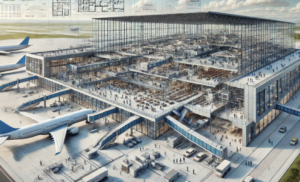
Airports in South Carolina are no longer “just buildings.” They are living systems made of terminals, gates, baggage handling, security, airfield pavements, utilities, fuel systems, IT networks, emergency power, and tight operational schedules that never stop. Every upgrade has to fit into a space that is already running at full speed, with travelers moving through it, airlines operating, and safety requirements that leave no room for guesswork.
That is exactly why BIM Services South Carolina matter for any South Carolina airport that wants smoother projects, fewer change orders, stronger coordination, and a facility that is easier to operate long after construction ends. Building Information Modeling is not a fancy 3D picture. It is a shared, data-rich way to plan, design, coordinate, build, and maintain airport infrastructure with clarity and control. When an airport invests in BIM, it invests in certainty.
Airports Have Become High-Complexity Construction Zones
Airport projects look simple from the outside, then reality hits. A terminal refresh touches architectural finishes, structural elements, life safety systems, accessibility requirements, concessions, and passenger flow. Airside work involves secure areas, strict phasing, and exact tolerances. Mechanical and electrical changes tie into systems that cannot fail, including emergency power, communications, and security technology.
BIM Services South Carolina give airport teams a coordinated environment where the full building and system relationships are visible before crews arrive on site. This is critical when a single conflict, like ductwork colliding with a structural beam or a conduit route blocking fire protection, can ripple into delays and expensive rework. Airports run on precision, and BIM is a precision tool.
Phasing and Maintaining Operations Are Easier With a Living Model
South Carolina airports often build while operating. That means night work, temporary routes, shifting entrances, secure corridor changes, and carefully staged shutdowns. Traditional 2D sets can communicate intent, but they struggle to show the real-world sequence of moves needed to keep passenger experience steady and safe.
With BIM, phasing can be modeled clearly so stakeholders see how work zones evolve, how routes change, and how each phase protects operations. The model becomes a visual plan that aligns airport leadership, airline station managers, contractors, security teams, and facility staff around the same expectations. When everyone can “see the plan,” coordination gets easier and surprises shrink.
Clash Detection Protects Schedule, Budget, and Safety
Airport projects contain dense MEP systems, security hardware, baggage conveyors, and technology pathways that compete for the same ceiling and corridor space. In an active terminal, a surprise clash is not just a design issue. It can become a shutdown, a reschedule, or an emergency change that pushes costs up fast.
BIM coordination and clash detection are built for this environment. Conflicts are identified early, resolved in preconstruction, and documented before materials are ordered. That reduces field improvisation, protects the schedule, and supports safer installation because crews are not forced into last-minute workarounds in tight spaces.
Baggage, Security, and Technology Upgrades Need Better Coordination
Baggage handling improvements and checkpoint expansions are some of the most disruptive projects an airport can take on. They touch structural supports, power loads, controls, scanning equipment, and passenger circulation. If these systems are not coordinated, airports risk bottlenecks, downtime, and frustrating change orders.
BIM Services South Carolina make it easier to map equipment footprints, electrical and data requirements, clearances, and maintenance access. It also improves coordination between design disciplines and specialty vendors, which is essential when the system is a combination of manufacturer requirements, code constraints, and airport operational preferences.
Airfield and Landside Work Benefit From BIM and Reality Capture
Airports are not only terminals. They are also runways, taxiways, aprons, stormwater, roadway access, parking, and utilities that extend far beyond the building footprint. When grading, drainage, and utility networks are involved, accuracy and coordination with existing conditions are everything.
BIM paired with survey data and reality capture helps teams understand what is truly in the ground and what clearances or conflicts exist across the site. That is especially important when airports need to keep traffic moving, maintain secure boundaries, and coordinate contractor access without creating confusion or safety risks.
BIM Supports Sustainability and Resilience Goals Without Guesswork 🌿⚡
Many airports are pursuing sustainability improvements, energy performance upgrades, and resilience planning. Whether the goal is better HVAC performance, more efficient lighting, improved stormwater management, or upgraded emergency power capacity, success depends on understanding how systems interact across the whole facility.
BIM supports analysis and coordination so design decisions are based on visible, testable information rather than assumptions. It also strengthens documentation for future improvements because the airport has a structured digital record of what was installed, where it lives, and how it ties into the larger system.
Digital Twins Turn Airport Construction Into Long-Term Operational Advantage
The biggest BIM payoff often comes after the ribbon cutting. A well-structured BIM deliverable can support facility management, maintenance planning, renovations, and asset lifecycle tracking. Airports that treat BIM as an operational foundation are positioned to reduce response time, plan capital improvements more accurately, and manage assets with fewer blind spots.
Airport industry reporting increasingly highlights the value of digital asset management and digital twin approaches, especially as airports modernize infrastructure and improve operational efficiency. Useful references that regularly cover airport infrastructure and technology modernization include FAA Airport News & Information, FAA Press Releases, and Airports Council International – North America Press Releases. For broader airport market updates and infrastructure coverage, sources like Aviation Week Airports & Networks and technology-focused airport coverage such as Airport Technology provide ongoing context. For airport background and reference detail, Wikipedia’s Charleston International Airport page is a convenient starting point for foundational information.
BIM Strengthens Communication Across Stakeholders
Airport projects involve more stakeholders than most construction environments. Airport authorities, engineering teams, tenants, airlines, TSA coordination, concession operators, and local agencies all have input. Misalignment is expensive.
BIM improves communication by giving each stakeholder a shared view of the project. Instead of translating intent from one set of drawings to another, teams can coordinate in a consistent digital environment. Decisions happen earlier, approvals move faster, and the entire process becomes less reactive.
Better Preconstruction Planning Reduces Change Orders and Delays
Change orders in airport projects can be brutal because they often come with operational impacts. A delayed ceiling closure can block a corridor reroute. A missed electrical load can push a system upgrade into a new phase. A field-discovered conflict can require re-permitting.
BIM Services South Carolina shift the effort forward into planning, coordination, and constructability. That is where airports win. The goal is not to “model everything.” The goal is to model what matters, coordinate what is risky, and document what will save time and money later.
South Carolina Airports Gain a Local Advantage With BIM Services South Carolina
Airports in South Carolina compete for airline service, passenger satisfaction, and capital improvement funding. Delivering projects on time, minimizing disruption, and building facilities that operate smoothly are strategic advantages, not just construction goals.
BIM Services South Carolina help airports move with confidence by improving coordination, supporting phased construction, protecting safety, and creating digital assets that remain valuable for years. When an airport treats BIM as part of its operational strategy, it builds more than a terminal upgrade. It builds momentum.
Conclusion ✅✈️
A South Carolina airport that uses BIM is choosing fewer surprises, clearer coordination, and stronger long-term control over its facility. BIM Services South Carolina support the realities airports face every day: nonstop operations, high security, dense building systems, and intense stakeholder coordination. The result is a smoother project today and a smarter facility tomorrow. 🧠🏗️