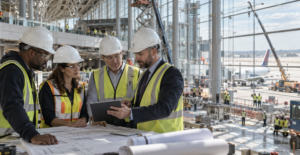
Airport construction is unlike almost any other form of development. A new terminal, runway rehabilitation, concourse expansion, security checkpoint redesign, baggage system upgrade, or air traffic control facility has to be built within an environment that often continues operating around the clock. Passengers still need to reach their gates. Airlines have schedules to maintain. Security requirements remain in force. Aircraft must move safely across runways and taxiways while contractors, engineers, suppliers, inspectors, and airport personnel coordinate work only a short distance away.
That complexity is one reason the owner’s representative has become increasingly important on major airport projects. Acting on behalf of the airport owner, an owner’s rep provides oversight that reaches across design, procurement, scheduling, budgeting, construction, communication, risk management, and closeout. Instead of allowing each participant to focus only on one portion of the project, the owner’s representative keeps attention on the owner’s broader objectives.
The need is becoming more apparent as investment in aviation infrastructure continues. The Federal Aviation Administration administers programs supporting projects involving runways, taxiways, lighting, signage, terminals, and other airport infrastructure. In September 2026 alone, the FAA announced $1.1 billion in Airport Improvement Program grants for projects across the United States, illustrating the scale of capital activity taking place throughout the aviation system.
Airport Construction Has Become an Exercise in Managing Complexity
Building at an airport involves far more than coordinating architects and contractors. Every construction decision can affect another part of airport operations. Temporary road closures influence passenger access. Utility relocations can affect terminal operations. Construction near aircraft movement areas may require strict scheduling and coordination. Security boundaries can change as construction progresses. A delay affecting one contractor may cascade into multiple phases of work.
Large airports can function almost like cities. They contain roads, parking facilities, utility systems, communications infrastructure, security systems, commercial spaces, maintenance buildings, baggage operations, passenger terminals, cargo facilities, emergency services, and extensive airfield infrastructure.
A useful overview of the different facilities and operating components that can exist within an airport is available through Wikipedia’s airport reference. The breadth of those systems helps explain why airport projects demand unusually strong coordination.
Traditional construction management remains essential, but airport owners increasingly need another layer of representation focused specifically on their interests.
That is the role an owner’s rep fills.
The Owner Needs Someone Looking at the Entire Project
Architects are responsible for design. Engineers concentrate on technical requirements. General contractors oversee construction activities. Specialty contractors manage their particular scopes. Airlines focus on operational needs. Government agencies oversee regulatory and safety requirements.
Every participant has an important job, but none necessarily has responsibility for viewing every decision exclusively from the owner’s perspective.
An owner’s representative occupies that position.
Professional Owners Rep Construction services can give airport owners an experienced advocate capable of tracking the project across disciplines while identifying potential conflicts before they become costly problems.
The distinction becomes particularly important on complex airport programs involving multiple contracts, phased work, public funding, operational restrictions, and numerous stakeholders. The owner’s rep becomes a central point of coordination while helping leadership maintain visibility into decisions that otherwise can become buried within hundreds of schedules, reports, change orders, drawings, meetings, and technical documents.
Keeping Airports Operational While Construction Moves Forward
One of the defining challenges of airport construction is that the facility frequently remains open.
A terminal renovation cannot simply disregard thousands of arriving and departing passengers. Runway work may have to occur within carefully controlled closures. Construction vehicles cannot move around an airfield as though it were a conventional commercial development. Passenger circulation, airline operations, emergency access, security procedures, concessions, ground transportation, and baggage handling may all need to continue while construction advances.
The result is a construction environment where sequencing becomes extraordinarily important.
An experienced owner’s rep can help coordinate phasing plans so construction teams understand not only what must be completed but when and under what operational conditions the work can occur. That coordination may involve overnight construction windows, temporary passenger routes, restricted staging areas, utility shutdown schedules, airline relocations, security changes, or carefully planned transitions between old and new facilities.
Airport safety adds another dimension. The FAA continues to emphasize investments involving runway and taxiway infrastructure as well as technology intended to improve visibility and reduce risks in aircraft movement areas. Recent federal initiatives have included funding for vehicle movement area transmitters designed to help controllers identify vehicles operating around runways and taxiways.
For owners, this reinforces an important principle. Airport construction decisions cannot be separated from airport operations and safety.
Controlling Costs Before Problems Become Change Orders
Cost control is another major reason owner representation has gained importance.
Large aviation projects can involve hundreds of millions or even billions of dollars. Small decisions multiplied across a major program can have enormous financial consequences.
An owner’s rep can review estimates, monitor budgets, examine proposed changes, track allowances, identify scope gaps, and challenge costs that require additional explanation. The objective is not simply to reduce spending. It is to make certain that the owner understands where the money is going and why.
This oversight becomes particularly valuable when unforeseen conditions arise.
An airport renovation may uncover outdated utilities. Existing infrastructure may not match old drawings. Equipment lead times may change. Additional security requirements may affect the original plan. Operational needs may force a construction sequence to be revised.
Without disciplined oversight, these changes can accumulate.
The U.S. Department of Transportation Newsroom regularly reports on transportation infrastructure investment, including major aviation projects. The substantial public and private resources flowing into airports make accountability and effective project controls increasingly significant.
An owner’s representative helps bring that discipline to the project throughout construction rather than attempting to reconcile problems after the budget has already been affected.
Schedule Management Can Be Just as Important as Budget Management
Airport projects are often connected to immovable operational deadlines.
A new concourse may need to open before a peak travel period. An airline may be preparing to relocate gates. A terminal transition may have to coincide with the commissioning of new baggage equipment. Seasonal weather can limit certain types of airfield construction. Federal grant requirements may also influence project timing.
Missing a milestone can therefore create costs that extend far beyond the construction contract.
Owner’s reps examine schedules from the owner’s point of view. They monitor dependencies, procurement timelines, approvals, testing requirements, inspections, and other factors that could threaten completion.
They can also help project participants recognize problems earlier.
A delay identified months in advance may provide several possible solutions. The same delay discovered shortly before a critical milestone may leave the owner with expensive choices and little flexibility.
That difference is one of the less visible benefits of strong owner representation.
Airport Growth Is Increasing Pressure on Existing Infrastructure
The challenge will not disappear as the aviation industry grows.
Airports Council International World reported that global passenger traffic reached approximately 9.8 billion travelers in 2025. Growing passenger demand places additional pressure on terminals, gates, baggage systems, roadways, security areas, passenger amenities, and airfield infrastructure.
Airport leaders must therefore think simultaneously about today’s operational requirements and tomorrow’s capacity.
Construction projects designed only around current conditions can become constrained sooner than expected. Owners’ representatives can help maintain focus on long-term objectives during planning and design, particularly when project teams encounter short-term pressures to reduce scope or alter important features.
Industry organizations such as the International Air Transport Association Pressroom also provide continuing coverage of passenger demand, airport capacity, airline operations, technology, sustainability, and other issues shaping aviation.
These developments matter because airport construction is no longer simply about replacing aging buildings. Modern airports are evolving transportation systems expected to accommodate changing technology, passenger expectations, security standards, airline requirements, accessibility needs, and future demand.
Technology Is Changing What Airports Need From Construction Teams
Modern airport projects increasingly incorporate sophisticated technology from the beginning.
Passenger processing systems, access controls, biometric technology, baggage tracking, digital signage, building management systems, communications networks, cybersecurity requirements, security screening equipment, sensors, automated systems, and operational databases can all intersect with the physical construction program.
Technology also means that substantial portions of an airport project must be tested and commissioned before opening.
A building may appear complete while critical operational systems remain unfinished.
Owner representation can help prevent technology from becoming isolated from the broader construction program. Coordination between IT teams, designers, contractors, airport operations personnel, airlines, security personnel, and equipment vendors must occur early enough for infrastructure requirements to be incorporated into the project.
Late technology decisions can lead to demolished walls, additional conduit, redesigned rooms, relocated equipment, new electrical requirements, or delayed commissioning.
Strong owner oversight reduces the chance that technology becomes an afterthought.
Security Requirements Add Another Layer of Coordination
Few construction environments operate under security requirements comparable to those surrounding commercial aviation.
Temporary construction walls, worker credentials, equipment movement, secured doors, passenger routing, access-controlled spaces, screening areas, and construction zones may all require special procedures.
The Transportation Security Administration’s news and press releases provide continuing updates on airport screening, security programs, passenger processing, and other developments affecting airport environments.
For construction teams, airport security requirements influence both design and execution.
Changes that seem minor in an ordinary commercial building can have significant implications inside an airport. Owner’s reps can help ensure security considerations remain connected to construction planning rather than being addressed only after conflicts emerge.
Communication May Be the Most Underrated Part of the Job
Major airport projects generate enormous amounts of information.
There are design meetings, contractor meetings, executive briefings, schedules, cost reports, requests for information, submittals, change proposals, inspection reports, risk registers, commissioning plans, operational readiness discussions, and regulatory reviews.
Information alone does not create effective oversight.
Airport executives need the right information at the right time.
One of the most valuable functions an owner’s representative can provide is translating an enormous volume of project activity into information the owner can actually use. Leadership should be able to understand what has changed, what decisions are required, what risks are emerging, how the budget is performing, and whether major milestones remain achievable.
That clarity can dramatically improve decision-making.
It also creates accountability. When responsibilities, decisions, deadlines, and costs are documented consistently, fewer issues disappear between organizations.
Federal Airport Investment Raises the Stakes for Project Delivery
Public investment continues to support major airport improvements throughout the United States.
Recent FAA grants have funded runway reconstruction, terminal expansion, taxiway improvements, passenger boarding bridges, airport access projects, lighting, towers, noise mitigation, and other infrastructure. In August 2026, for example, the FAA announced $870 million for airport infrastructure projects across 44 states and two territories.
Additional federal announcements have continued since then, including the September 2026 Airport Improvement Program awards.
Large investments create opportunity, but funding alone does not guarantee successful delivery.
Projects still require planning, coordination, procurement, design management, construction oversight, documentation, financial controls, operational integration, testing, and closeout.
An owner’s representative provides continuity across those stages.
Owners’ Reps Are Becoming Part of the Modern Airport Project Team
The growing role of owners’ representatives reflects a broader change in airport development.
Projects have become too interconnected for owners to rely solely on fragmented oversight. Airport construction now sits at the intersection of infrastructure, technology, security, passenger experience, airline operations, government regulation, public funding, and long-term capacity planning.
Someone has to maintain a comprehensive view.
That person does not replace the architect, engineer, contractor, program manager, airport operations team, or government regulator. Instead, the owner’s rep connects their work to the priorities of the organization paying for and ultimately operating the finished project.
That is why the role can be easy to overlook from outside the industry while remaining so influential inside a successful project.
Conclusion
The most visible elements of airport construction are easy to recognize. Travelers see new terminals, expanded concourses, modernized checkpoints, improved roadways, renovated gates, and upgraded passenger amenities. Behind those improvements is a far more complicated process involving thousands of decisions that must align before the first passenger ever enters the completed space.
Owners’ representatives are becoming essential because they provide something increasingly difficult to achieve on complex aviation projects: consistent oversight from the owner’s perspective.
They help protect budgets, monitor schedules, coordinate stakeholders, manage risk, support operational continuity, integrate technology, track decisions, and keep project objectives visible from planning through completion.
As airports continue investing in modernization and capacity, the success of those projects will depend not only on what gets designed and built, but also on how effectively every moving part is managed.
The owner’s representative is becoming the force that helps keep those parts moving in the same direction.