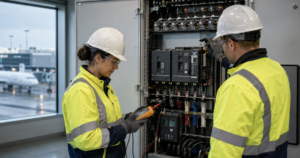
Airports operate like small cities that never sleep. Terminals, baggage systems, runway lighting, security checkpoints, maintenance facilities, restaurants, communications equipment, and emergency services all depend on a steady supply of electricity. Even a brief electrical interruption can affect passengers, delay flights, disrupt airport businesses, and place additional pressure on operations teams.
Reliable circuit protection is therefore an important part of airport infrastructure. Circuit breakers help protect electrical systems against overloads and short circuits by interrupting the flow of electricity when unsafe conditions occur. In facilities that already use compatible General Electric equipment, properly selected GE Breakers can help facility managers maintain dependable electrical distribution while supporting maintenance, replacement, and expansion projects.
Electrical reliability is rarely the subject of major airport news until something goes wrong. Behind every smooth departure, illuminated runway, operating baggage carousel, and functioning security checkpoint is an extensive electrical network that must perform safely around the clock.
Airports Depend on Electricity at Every Level
Modern airports use electricity in nearly every part of their daily operations. Power is required for terminal lighting, escalators, elevators, ticketing kiosks, departure displays, passenger boarding bridges, ventilation systems, communications networks, and emergency equipment. It also supports airfield lighting, navigation-related infrastructure, fueling operations, aircraft maintenance facilities, and ground transportation systems.
According to the Federal Aviation Administration’s Airport Safety Program, airport safety responsibilities include runway safety, certification requirements, safety management systems, and other operational concerns. Although circuit breakers represent only one part of a much larger infrastructure, dependable electrical protection supports many of the systems used to maintain a safe airport environment.
A tripped or failed breaker in an ordinary commercial building may inconvenience employees or customers. At an airport, an electrical problem can have wider consequences. It may interrupt a baggage conveyor, darken part of a terminal, disable equipment in a tenant space, or require maintenance personnel to respond immediately. These interruptions can spread quickly when multiple systems depend on the same electrical distribution network.
That is why airport electrical systems require careful planning, accurate documentation, preventive maintenance, and components that match the specifications of the installed equipment.
The Essential Role of Circuit Breakers
A circuit breaker is designed to interrupt an electrical circuit when current exceeds safe operating limits. Excessive current can result from an overloaded circuit, damaged equipment, deteriorated wiring, or a short circuit. Without suitable protection, excess current can overheat conductors and equipment, increasing the potential for damage, fire, and operational disruption.
The basic function sounds straightforward, but airport electrical networks can be extensive and complex. A single airport may contain multiple terminals, hangars, control facilities, parking structures, rental car areas, cargo buildings, mechanical rooms, and utility spaces. Different sections may have been constructed or renovated at different times, creating a mixture of electrical equipment generations.
The Wikipedia overview of airports illustrates how many facilities and operational areas can exist within an airport property. Each area presents its own electrical demands, making coordinated circuit protection important throughout the campus.
Circuit breakers also help maintenance teams isolate affected circuits. When an electrical fault occurs, properly coordinated protection can limit the interruption to a smaller portion of the system instead of allowing one problem to affect an entire building or operating area. This selectivity is especially valuable in airports, where continuity is essential.
Why Compatibility Matters in Airport Electrical Systems
A replacement breaker must be compatible with the electrical panel, switchboard, or other equipment in which it will be installed. Physical appearance alone does not establish compatibility. Breakers may differ in voltage rating, amperage, interrupting capacity, number of poles, mounting configuration, trip characteristics, and applicable listings.
For airports with existing GE electrical distribution equipment, the correct GE breaker may be needed to preserve the intended configuration of a panel or switchboard. Airports often contain equipment installed during several construction periods, so identifying an existing breaker may require more than reading a single number from its face.
Facility managers and electricians should document the manufacturer, complete catalog number, frame type, trip rating, voltage, poles, interrupting rating, and panel information before obtaining a replacement. Photographs of the breaker, label, mounting arrangement, and equipment data plate can also help reduce identification errors.
The Occupational Safety and Health Administration’s electrical safety resources reinforce the importance of recognizing and controlling electrical hazards in the workplace. Breaker inspection and replacement should always be performed by qualified personnel using appropriate procedures and protective equipment.
Supporting Continuous Airport Operations
Airports function on demanding schedules. Flight arrivals and departures continue early in the morning, late at night, during severe weather, and throughout busy travel periods. Many airport systems must remain available even when passenger traffic is low because cleaning, maintenance, cargo handling, security, and airline operations continue behind the scenes.
The Transportation Security Administration’s news center regularly reports on changing passenger volumes, security operations, and travel conditions. High passenger traffic places additional demands on airport facilities, including elevators, baggage systems, food-service equipment, charging stations, lighting, and climate control.
Reliable circuit protection contributes to operational continuity by responding when abnormal current conditions arise. A correctly specified breaker cannot prevent every power problem, but it can help protect connected circuits and equipment from certain electrical faults.
Maintenance departments also benefit from keeping accurate records of installed breakers and suitable replacements. When a breaker must be replaced, a complete equipment inventory can shorten the identification and procurement process. This preparation is valuable when dealing with older equipment or breakers that may not be readily available through ordinary retail suppliers.
Protecting Safety-Critical Airport Systems
Some airport systems have direct connections to passenger and employee safety. Emergency lighting, fire alarms, communications equipment, access-control systems, runway lighting, and rescue facilities must be supported by carefully designed electrical infrastructure. Many of these systems include backup power arrangements, but their normal and emergency circuits still require suitable overcurrent protection.
The FAA explains that airports certificated under Part 139 Airport Certification must meet requirements involving areas such as signs, lights, markings, emergency response, fueling safety, and snow and ice control. Each of these responsibilities may rely on electrical equipment somewhere within the airport.
The National Transportation Safety Board’s Office of Aviation Safety investigates aviation accidents and significant incidents to identify safety issues and improve transportation. Its work demonstrates the broader aviation principle that safety depends on preparation, system integrity, documentation, and learning from failures.
Electrical maintenance fits naturally within that culture. Routine inspection can reveal loose connections, overheating, corrosion, contamination, nuisance tripping, damaged enclosures, or obsolete components before they contribute to a larger problem.
Maintenance and Inspection Build Long-Term Reliability
Circuit breakers should be included in an airport’s preventive maintenance program. The appropriate inspection and testing schedule depends on the equipment, manufacturer recommendations, operating conditions, applicable codes, engineering guidance, and the importance of the circuits being protected.
Airports can expose electrical equipment to demanding conditions. Temperature changes, vibration, moisture, dust, deicing chemicals, vehicle exhaust, and heavy usage may affect equipment depending on its location. A breaker installed in a controlled terminal electrical room faces different conditions from equipment serving a hangar, maintenance facility, or outdoor installation.
Signs of a possible problem may include repeated tripping, heat discoloration, unusual odors, visible damage, buzzing sounds, corrosion, or evidence of loose connections. Repeatedly resetting a breaker without identifying the cause can allow a serious underlying condition to remain unresolved. A qualified electrician should investigate recurring trips and determine whether the problem involves the breaker, wiring, load, connected equipment, or another part of the distribution system.
The International Civil Aviation Organization’s safety resources emphasize coordinated planning, safety management, compliance, and continuous improvement across global aviation. That same disciplined approach is useful when managing airport electrical assets.
Planning for Expansion and Modernization
Airports continually evolve. New gates, renovated terminals, electric ground-support equipment, additional charging stations, advanced baggage systems, and upgraded security technologies can increase electrical demand. A circuit that performed adequately years ago may no longer be appropriate after equipment or usage changes.
Electrical upgrades should begin with a professional assessment of existing loads, available capacity, fault-current conditions, coordination requirements, and future plans. Adding a larger breaker to accommodate increased demand without evaluating the wiring and equipment can create a dangerous mismatch. Breaker size must correspond with conductor capacity, connected equipment, system design, and applicable electrical requirements.
Airport modernization projects should also include updated panel schedules and equipment records. Clear labeling helps maintenance teams identify circuits faster during routine work and emergencies. Spare breaker planning may also reduce downtime when specialized or older components are difficult to source.
Selecting the Correct Replacement Breaker
The safest replacement is not simply a breaker that fits into an opening. It must meet the electrical and mechanical requirements of the equipment and application. Purchasing teams should work from verified specifications supplied by qualified electrical professionals.
Important details include the exact model or catalog number, voltage, amperage, poles, interrupting rating, trip function, frame size, mounting style, and equipment compatibility. Condition and provenance also matter, particularly when sourcing breakers for legacy airport equipment.
Any replacement component should be examined before installation. Packaging, labels, terminal condition, operating mechanism, and identifying marks should be checked. Airport procurement departments should use reputable suppliers that can provide accurate information and help identify the required equipment from photographs, nameplates, and part numbers.
The Airports Council International World news section covers airport development, operational priorities, sustainability, technology, and industry initiatives. As airports invest in modernization, dependable electrical distribution remains a practical foundation beneath more visible improvements. 🔧
Conclusion
Airport reliability depends on thousands of systems working together. Circuit breakers may remain out of sight in electrical rooms and equipment cabinets, yet they perform an essential protective function every day.
For airports equipped with compatible GE electrical systems, accurately identified GE circuit breakers can support safe maintenance, dependable operation, and thoughtful modernization. The correct breaker must match the equipment, electrical ratings, system design, and operational requirements. Installation and testing should always be handled by qualified professionals.
A strong airport electrical program combines suitable equipment with accurate records, routine inspection, preventive maintenance, emergency planning, and careful procurement. Those practices help protect airport facilities, reduce unnecessary interruptions, and support the reliable operations that passengers, employees, airlines, and surrounding communities depend upon every day. ✈️